For years, the grants process municipalities used worked — until it didn’t. One Canadian municipality found itself managing a growing portfolio of community funding programs on a foundation of emails, PDFs, and spreadsheets. The volume increased, the cracks widened, and the community organizations that depended on that funding were the ones most impacted. Here’s how modernization helped this organization keep pace:
The City was doing important work — just not efficiently
Our client, a mid-sized Canadian municipality, ran multiple public funding programs: community grants, event funding, and social support initiatives aimed at strengthening local organizations and improving citizen services. While their governance framework was solid and the intent was right, the engine running it all was held together with manual effort and goodwill.
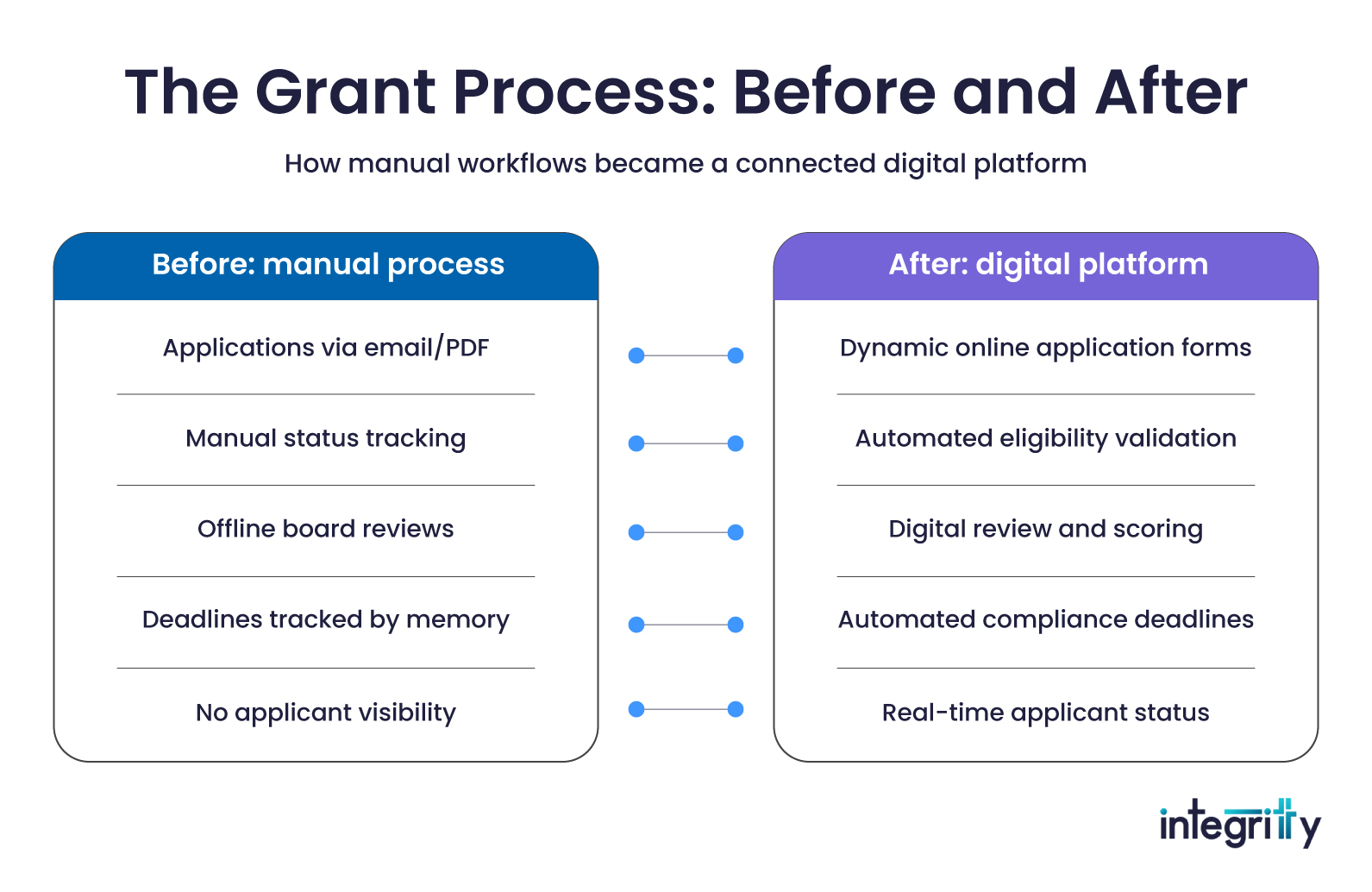
If you’ve ever been part of a manual process, you know the story: applications arriving by mail or email, staff organizing PDF attachments, chasing down missing information, and manually tracking submission status. Advisory board reviews happen offline, and scoring sheets are passed between reviewers without a consistent system behind them. Compliance deadlines are monitored by memory and calendar reminders — exposed to human error and at risk of being overlooked.
For the community organizations applying for funding, this experience is frustrating. With no access to application status without calling in, staff are bogged down, digging through inboxes to find an answer.
As population growth and other economic factors push demand for funding programs higher, the gap between what this City needed and what its process could handle became impossible to ignore.
Everything, all at once: the making of a breaking point
When Integritty came in for a current-state assessment, the picture that emerged wasn’t a single broken process. It was a system of workarounds that had become the process.
No centralized platform meant no single source of truth. Grant lifecycle stages — intake, evaluation, approval, disbursement, compliance reporting — lived in different places, owned by different people, tracked in different ways. Visibility was limited, auditability was weak, and with no analytics to speak of, leadership had little ability to assess funding impact or make evidence-based decisions about program investment.
The risks were real: inconsistent evaluation outcomes, compliance gaps, and the applicant experience quietly discouraged the community engagement this City was actively trying to build.
Our approach: build around how the City actually works
Integritty’s starting point wasn’t technology — it was process. Before a single system was configured, the team mapped the complete grant lifecycle end to end, from first application touch to final compliance sign-off. Stakeholder journeys were documented: policy rules — eligibility criteria, funding limits, approval thresholds — were identified and structured for system logic.
The goal was a platform that reflected how this municipality actually operates, not one that forced the city to adapt to a generic tool. That meant configurable workflows aligned to the City’s advisory board structure and Council approval hierarchy, policy-driven validation baked into the intake process, and an applicant-facing portal designed to reduce friction at every step.
Integration readiness with existing finance systems was built in from the start — not bolted on after the fact.
What we built: a platform covering the full grant lifecycle
The solution Integritty delivered digitized and automated every stage of the funding process — nothing was left running manually on the side.
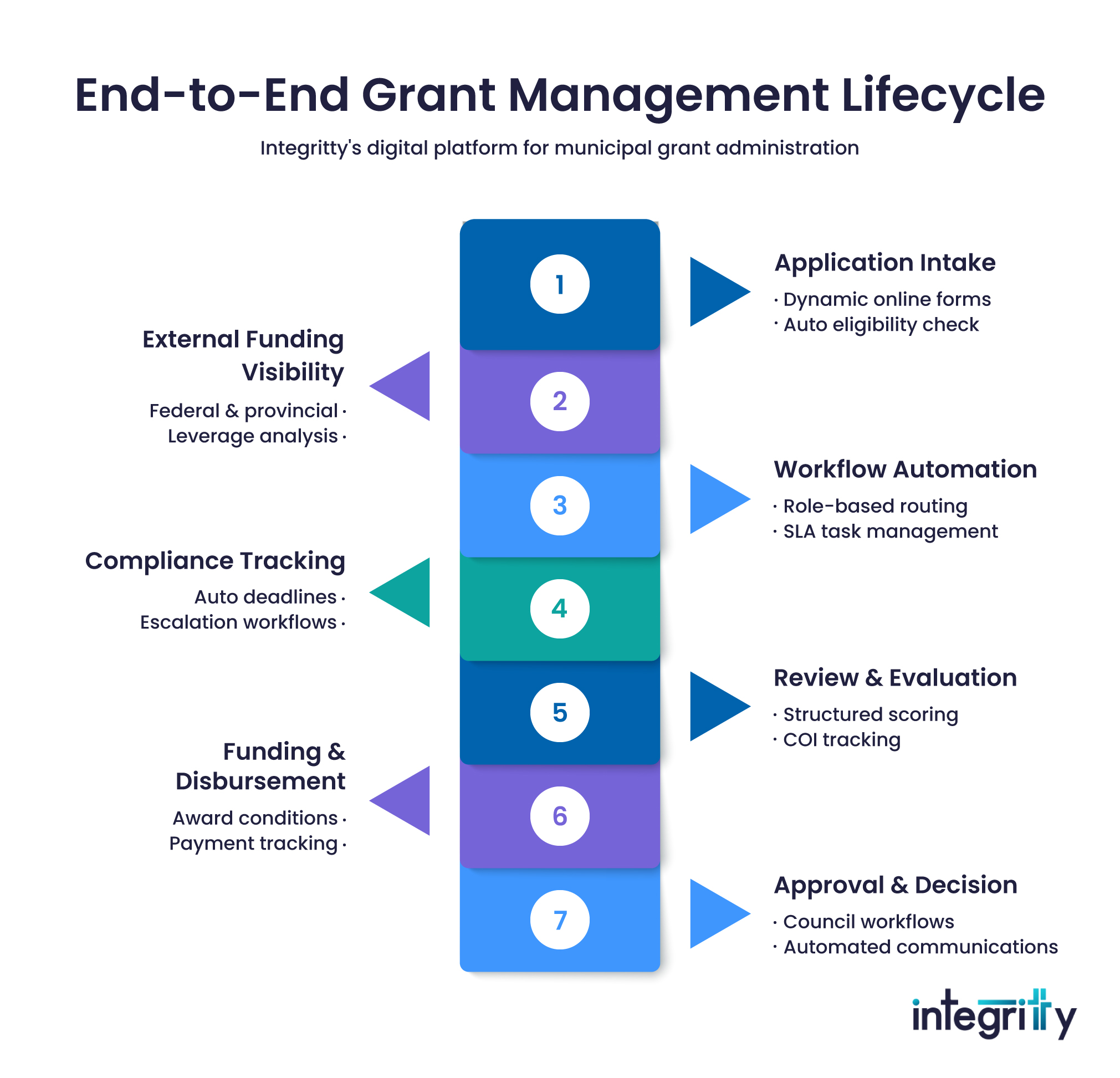
Intake moved from email and PDF to dynamic online forms with automated eligibility validation. Incomplete or ineligible submissions were caught before they entered the queue. Applicants could track their status in real time without picking up the phone.
Workflow and case management brought every stage — submission, screening, review, approval, disbursement, close-out — into a single automated system with role-based routing, SLA-driven task management, and a full audit trail on every action taken.
Review and evaluation shifted to a dedicated digital portal where reviewers scored applications against structured municipal criteria. Score aggregation was automated. Conflict-of-interest disclosures were tracked. Reviewer access was controlled throughout.
Approval and decision management gave Council and committee workflows a streamlined, configurable home — complete with decision logs, rationale tracking, and automated applicant communications on outcomes.
Disbursement tracking connected award conditions and payment schedules to a finance-integration-ready framework, with real-time visibility into planned versus actual payments.
Compliance stopped being a manual chase. Reporting tasks and deadlines were generated automatically, with built-in reminders and escalation workflows. Organizations that missed reporting requirements were flagged as ineligible for future funding — enforced by the system, not by someone’s memory.
External funding visibility rounded out the platform — a tracking module that connected federal, provincial, and non-profit funding sources to municipal grants for leverage analysis and a complete view of the funding ecosystem.
The difference this makes: the reality behind the numbers
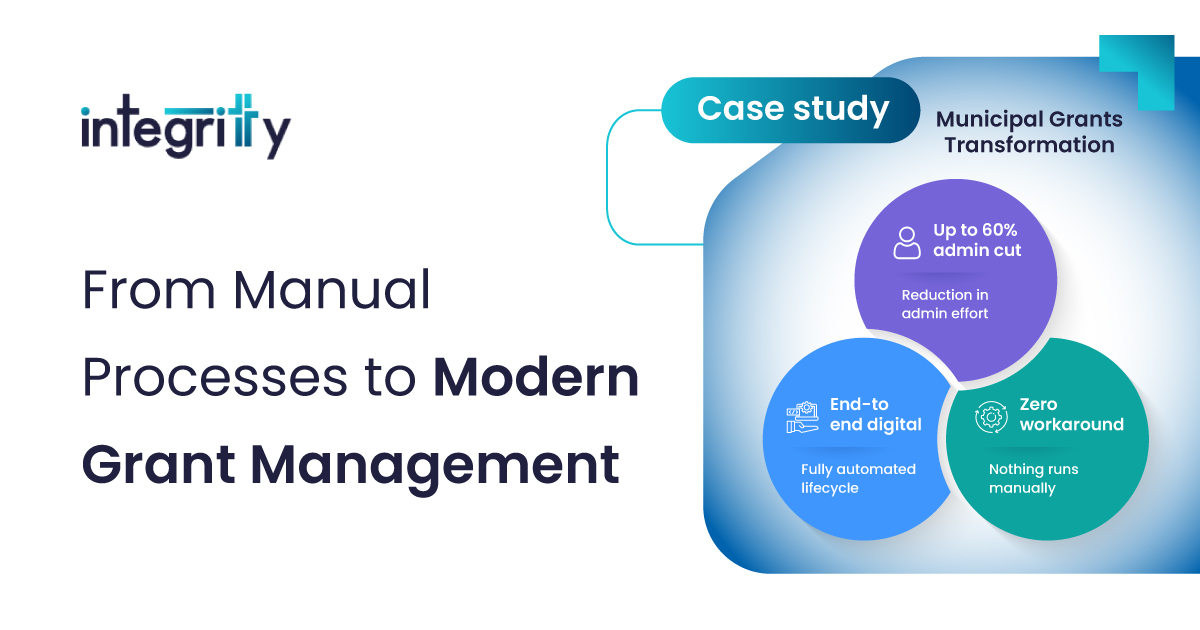
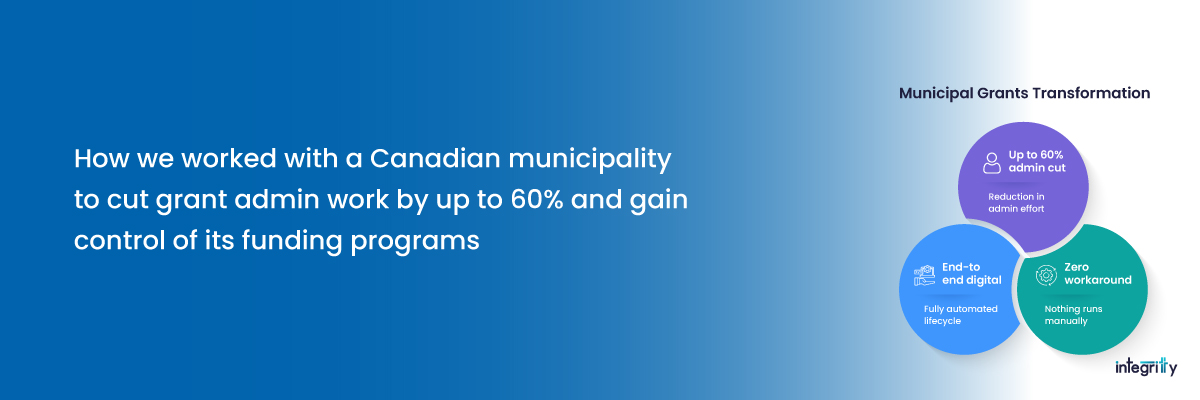
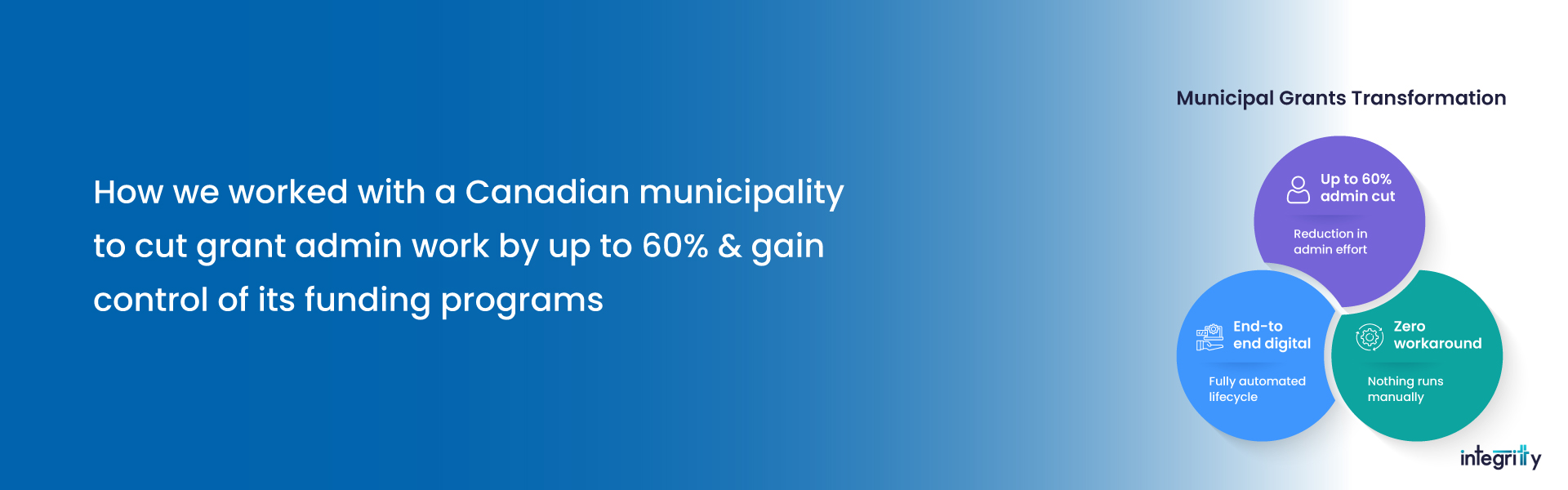
Up to 60% reduction in manual administrative effort across intake and review is the headline stat — and it’s real. But the more meaningful shift was what that time reclaimed for the grant administrators:
Management
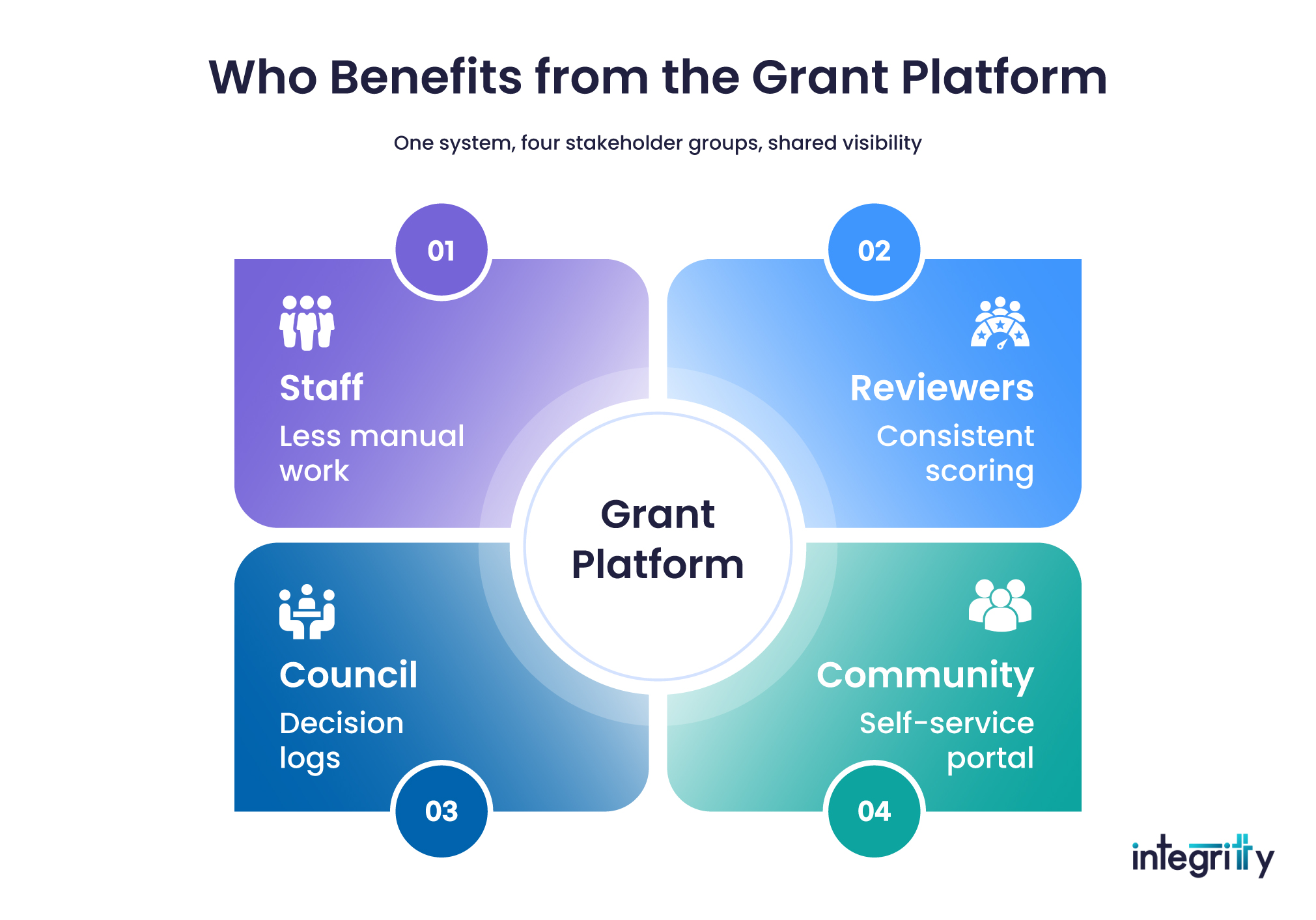
- Staff who had spent hours sorting emails and tracking down submissions could focus on higher-value work
- Reviewers had consistent tools and criteria, which meant evaluation outcomes were fairer and more defensible
- Council had decision logs and rationale on record — not just a recommendation from memory
Manual admin doesn’t fail all at once — it degrades slowly. We helped a Canadian municipality cut grant admin effort by up to 60% with a digital grant management platform. Staff got time back, reviewers got consistent criteria, Council got a documented trail.
For community organizations, the experience improved in ways that mattered. A self-service portal, real-time status updates, and a cleaner application process meant more engagement from the organizations the city was trying to support, not less.
And for the first time, leadership had centralized dashboards showing funding allocation, program outcomes, and community impact. Grant management shifted from reactive to strategic.
What This Means If You're Running a Similar Program
Manual grant administration doesn’t fail dramatically — it degrades slowly. Processes that worked at a smaller scale become liabilities as demand grows, and the organizations depending on public funding are the ones absorbing the friction.
This project demonstrated what’s possible when digital transformation in the public sector is approached seriously: not as a tech installation, but as a rethink of how a city delivers on its commitments to the community.
If your municipality or public sector organization is managing grants, permits, or funding programs on processes that were never designed to scale, this is a conversation worth having.
Get in touch with Integritty to explore what a purpose-built solution looks like for your 8programs, your governance structure, and your community.